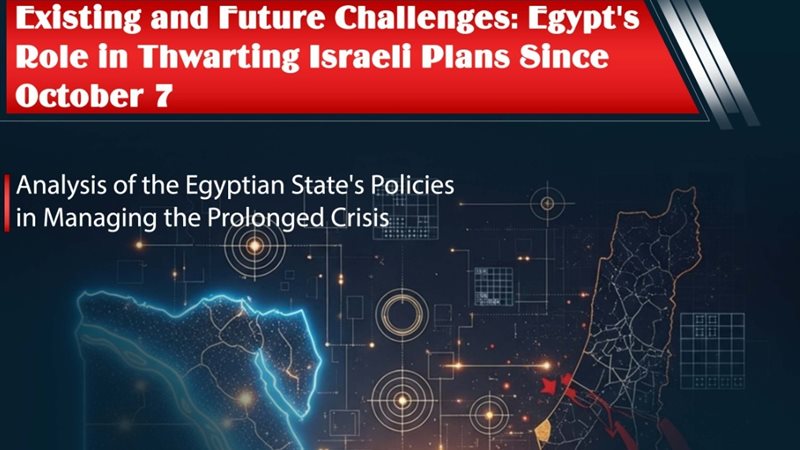
Existing and Future Challenges: Egypt's Role in Thwarting Israeli Plans Since October 7

Abstract
From October 7, 2023, to the present, Egypt has dealt with the Palestinian-Israeli crisis as a central test of its regional role and international standing. Cairo has employed balanced tools that combine active political mediation with national security control. It has cautiously managed the Rafah crossing and humanitarian relief, reflecting its commitment to protecting Palestinians without threatening the stability of Sinai. It has also led influential efforts in hostage exchange deals and managing the ceasefire, and has confronted challenges with smuggling networks and tunnels through extensive security interventions. Regionally, Egypt has strengthened its partnerships with Arab actors, while maintaining open channels with the United States and Israel within the framework of a delicate balance that protects its strategic interests. Internationally, it has employed its tools at the United Nations to affirm the two-state solution and reject attempts to impose unilateral settlements. Cairo is moving towards an approach driven by its historical role, making it an indispensable player in any future settlement, despite growing challenges that require a restructuring of its diplomatic and security tools.
Introduction
The October 7, 2023 war marked a turning point in a series of political, military, and regional interactions. From this point, Cairo began repositioning its foreign and regional policies in response to a combination of internal pressures and real security threats on its borders. During the first months, Egypt immediately shifted to playing the traditional mediator role, doubling its contacts with Doha, Washington, and regional actors, while working to strengthen its security capabilities in Sinai. A series of events then placed Cairo in a position of overlapping reaction and preemption: (a) intensive Israeli operations in areas near Rafah, leading to tensions at the crossing and the successive suspension of aid; (b) regional and international discussions and rumors regarding the restructuring of Gaza and alternatives for its post-war administration (including proposals for temporary transfer or resettlement); (c) Arab and international pressures prompted an emergency Arab summit in Cairo in March 2025, which adopted an Egyptian reconstruction plan as an alternative to proposals for "displacement" or unilateral administration.
Over the extended period, Cairo pursued a multi-faceted policy: continuing mediation to resolve hostage exchanges and a temporary ceasefire; managing and monitoring the crossings (the Rafah crossing being at the forefront); enhancing security in Sinai to prevent operational spillovers; and forming an Arab diplomatic front supporting the reconstruction proposal and preserving the survival of the population in the Gaza Strip. These tools were evident in practice, but their results varied depending on the changing field, regional, and international pressures.
Full Study - From Here